I have a lot of polymorphisms or “SNPs” in the glyoxylate metabolic pathway. Both of my parents were kidney-stone-formers, and most kidney stones are calcium-oxalate.
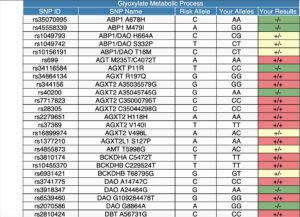
After my mold exposure—I moved out of a moldy house in Dutchess County, NY, in 2014—I suffered from orthostatic intolerance, night sweats, and alternating periods of extreme urine retention and extremely frequent urination. It was as if my body could not decide how much water to retain. I believe some of these symptoms were the result of a homozygous mutation at rs699. The angiotensinogen (AGT) gene helps the body regulate the renin-aldosterone-angiotensin system, which is known to be dysregulated in patients with ME/CFS. Here you can see my many SNPs in the glyoxylate metabolic pathway, including AGT:
Because both my parents were kidney-stone-formers, I eat a low oxalate diet. After a while, I began to suspect that my brain was using oxalate as a measure of density—a way of determining a value for the density of the light of the world. Oxalate is a crystal found in plants capable of photosynthesis. For some people, like me, eating a high-oxalate diet can cause joint pain, fatigue, rashes, interstitial cystitis, mitochondrial dysfunction, and many other symptoms.
Like many with POTS and chronic fatigue issues, to keep my blood pressure feeling normal, I sometimes needed to salt-load. After a while, salt-loading and dealing with my orthostatic intolerance issues began to give me insights into sodium, pH7, and potassium.
We see density as a passive variable. But perhaps density can be expressed in terms of how tightly or loosely something holds together. Something that is holding together very tightly is very dense. Something that is holding together very loosely is very diffuse. I began to feel that sodium, pH7, and potassium were different iterations of the same thing, the same baseline density. It was as if sodium was water that was holding together too tightly, and potassium was water that was holding together too loosely. Perhaps because of my rs699 SNP, I became very sensitive to the way sodium and potassium feel.
But there was a problem. If the water in my body was behaving like potassium—was holding together too loosely—and I was perceiving the background as being too high in magnetism (too high in iron), the two distortions would hold each other in place. And it was self-reinforcing: when I hold together too loosely, I am more sensitive to the magnetic force.
Similarly, if the water in my body was behaving like sodium—was holding together too tightly—and the background was simultaneously not holding together tightly enough (i.e. was high manganese), the two distortions would hold each other in place. This, too, was self-reinforcing: when I hold together too tightly, I am less sensitive to the magnetic force.
The more magnetic I am, the less sensitive I am to magnetism.
And, worse: each of these distortions would create significant problems with my blood. When I was too watery, was holding together too loosely, my demand for vitamin K1 would spike. I recognized this combination (retaining water and also craving clotting factors) as similar to the effects of when my estrogen would spike. I may be too watery, but my blood cannot be too watery and still function efficiently as blood.
Conversely, when I was too dehydrated, was holding together too tightly, my blood … it is as if my blood becomes slightly magnetic. My platelets begin to feel hyper-reactive and “hot,” as if they are over-eager to clot. When I am too watery, my K1 needs to increase; when I am too dehydrated, my K1 needs to be suppressed. Because “dehydrated,” here, does not mean what you are accustomed to it meaning. “Dehydrated” means I am holding together too tightly—mimicking sodium, rather than mimicking pH7. When I am holding together too tightly, mimicking sodium, my blood is already (sub-clinically) a little too thick.
Water as water is water. But so is steam. Steam is water that is holding together too loosely—because the background energy is too high. I can simulate the feeling of background energy that is too high by eating too much iron. When the background is iron, and I am steam, I can’t condense (ALS?).
Water as water is water. But so is ice. Ice is water that is holding together too tightly—because the background energy is too low. I can simulate the feeling of background energy that is too low by eating too much manganese. When the background is manganese, and I am ice, I can’t melt (Parkinson’?).
Ice, water, and steam are all fundamentally the same thing. Sometimes I wonder if the baseline density of the universe is constant. It just feels “hot” when it is expanding, and “cold” when it is condensing. At least, that is the way it feels to me.
A lot of my health problems seemed to stem from a failure to synchronize with baseline density. Often, this was the result of toxic exposures (post-mold, I am chemically sensitive) or to giving my brain bad information.
If my perspective is too high-iron, and I am holding together too tightly, it is as if I am condensing. When I am condensing, the whole world seems to be expanding. I can induce this feeling with too much choline, too many egg yolks, too much iron (red meat), or by over-stimulating the cholinergic system—for instance, if I drink lemon juice or put lemon on my food all day every day. When I tell my brain that reality is much more bitter than I am, my brain thinks time is going “in”—that the world is condensing.
If my perspective is too high-manganese, and I am holding together too loosely, it is as if I am expanding. When I am expanding, the whole world seems to be condensing. When my perspective is that of manganese, the whole world reads as iron. When I took a supplement designed to help high cortisol that contained manganese, I took too much. Combined with vitamin D, it gave me the feeling that my body was imploding—being pulled inward and downward by a huge magnet. I write more about this experience in an essay, “Density and Diffusion: The Hidden D’s of Disease.”
My aunt has Parkinson’s, and my mother has Alzheimer’s. I am wary, naturally, of going “in” too quickly, or not quickly enough. For me, especially since menopause, I seem to need more choline. I was told there were some fatty infiltrations in my liver (NAFLD), and I can feel that I have lost cognitive speed. I find that bile acid signaling is central not just for my liver and digestion, but for my brain. I had a very positive response to acetyl-L-carnitine. But I have a hard time taking supplemental choline. It can stimulate my symptoms of PCOS, polycystic ovarian syndrome, which I then need to quell with inositol. It is a balancing act.
But with a fatty liver, and a mother (and two grandparents) with Alzheimer’s, I soldiered on with supplemental choline, even though taking it was difficult for me. After a while, I could feel what the problem was. When I go “in” via bile, choline, or the perception of bitterness, the pressure in the system increases. (I can also go “in” a tiny bit, and relieve migraine symptoms, with a micro dose of psychedelics.) But when I go “in,” I need to release the pressure in the system, to “open the valve,” so to speak. Otherwise, the pressure in the system feels too high. I can open the valve with niacin, or nitric oxide. When I dive too deep too quickly, I have to open the valve too wide, and the system becomes dysregulated. For instance, the week I received mercury fillings. Tiny bubbles rose to the surface of my skin, and caused desquamation.
When I dive too deep too quickly, it is like deep-sea diving—only, instead of being under water, it is as if I am under light. When I rise to the surface or “open the valve” too quickly, it is as if I give myself the bends.
I write more about this way of thinking in a peer-reviewed paper, “Time and the body: a new approach to disease.”
