Chronic Fatigue Syndrome
My health problems began with mold exposure. For some people, mold can trigger ME/CFS or myalgic encephalomyelitis, a debilitating disease also known by the unfortunate moniker Chronic Fatigue Syndrome. This name diminishes the severity of ME/CFS. While my response to mold included crushing fatigue and orthostatic intolerance—when your body can’t adapt quickly enough to changes in blood pressure—it was 1/100000th what people like Whitney Dafoe, who has had debilitating ME/CFS for decades, has endured.
But Whitney and I did have something in common. I read that his blood was so thick it had once prevented doctors from being able to get a blood draw. Before I became sick, I donated blood and was shocked by my own blood viscosity when observed out of context (outside my body). It was incredibly thick. After I had been in the chair for longer than anyone else and the room had cleared, a nurse approached me. “I’m sorry,” she said, “but if your blood does not begin to fill the bag more quickly, we are going to have to throw it away.”
As I studied photographs of Whitney Dafoe, I had a lightbulb moment. He suddenly looked huge to me. Not literally huge—he was to scale with the rest of his world—but huge from a certain angle, in a certain sense. I think I was glimpsing his holographic volume—his size, relative to his blood volume. I believe Whitney is too big for his blood. After living in mold, I felt like this:
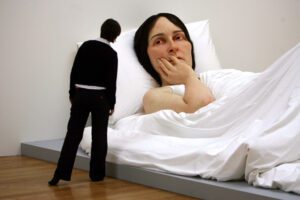
Mandatory Credit: Photo by James Fraser/Shutterstock (603982e)
Sculpture by Ron Mueck, In Bed, 2006
Ron Mueck art exhibition, Royal Scottish Academy, Edinburgh, Scotland, Britain – 04 Aug 2006
What if, when we are too big, too “smeared out” in time, as if on top of a mountain, our blood has to be too thick? And when we are too dense, too “contracted” in time, as if at the bottom of the pool, our blood has to be too thin? Several people with mold sickness, including science writer Julie Rehmeyer, have found relief, at least temporarily, while camping in Death Valley, which is located 282 feet below sea level.
The “all in the small”
There is a fractal principle known as the “all in the small” that is perhaps best expressed by John Muir. “There is no fragment in all nature, for every relative fragment of a thing is a complete harmonious unity in itself.”
In a holographic universe, scale matters. If I eat a lot of glycine, the smallest amino acid, my brain’s understanding of the scale of the world is different than if I eat a lot of tryptophan, the largest amino acid. When I am rendering myself out of proteins that are too small, it makes my blood too large and watery, by comparison. When the blood is too large and watery, it can no longer speak to the cells. It is as if it has become too pixelated.
Glyphosate, a chemical pesticide found in non-organic food, is a glycine analogue. Glyphosate gives my brain distorted information about scale. It has been linked to cancer and numerous other diseases (Samsel & Seneff, 2016). Switching to a 100% organic diet, zero glyphosate, was central to my recovery.
If consuming the tiniest amino acid, glycine, made me feel terrible, would consuming the largest amino acid, tryptophan, make me feel good? It did. And, interestingly—especially with my mother’s Alzheimer’s—I discovered there was new research looking at Alzheimer’s in terms of tryptophan metabolism.
However, if the reason my blood volume is too small is that the image of my body is too large, taking tryptophan as a supplement will, ultimately, perpetuate the problem. Often, I think many disease states involve getting caught in feedback loops.
I also began to wonder if it was precisely because my image was too large—too “smeared out” in time—that oxalate was a problem for me. Is it possible that oxalate reads as “too dense” when the observer is “too diffuse”? A high-oxalate diet, such as one with daily green smoothies, seems to devastate some people’s health—but not others’. When injected into breast tissue, oxalate is known to induce breast cancer.
The overarching feeling I had after my mold exposure was one of being trapped in time. It was as if my blood were two things at once: both too thick, and too smeared out. It was fundamentally too thick, but functionally too thin. This is what trapped me. I was too thick to condense, and too thin to expand.
